When Purchasing Slitter Blades, How to Judge the Manufacturer's Process Level Through Appearance Details?
Sep 08, 2026
When purchasing slitter blades, many users only focus on price and material, while overlooking the ability to judge the manufacturer's true process level through appearance details. When you receive a blade, professionals know what to look for, while amateurs just see the surface. Mingbai Mechanical Tool Technology Co., Ltd., based on years of manufacturing experience, summarizes seven key details that can help you judge a manufacturer's process level just by looking at the blade.
1. Check the Parallelism of the Two Major Faces — The "First Impression" of Precision Level
The quality precision of slitter blades is mainly reflected in three aspects: thickness tolerance, parallelism between the two major faces, and surface roughness of the major faces. Parallelism is the core indicator for measuring a manufacturer's machining capability.
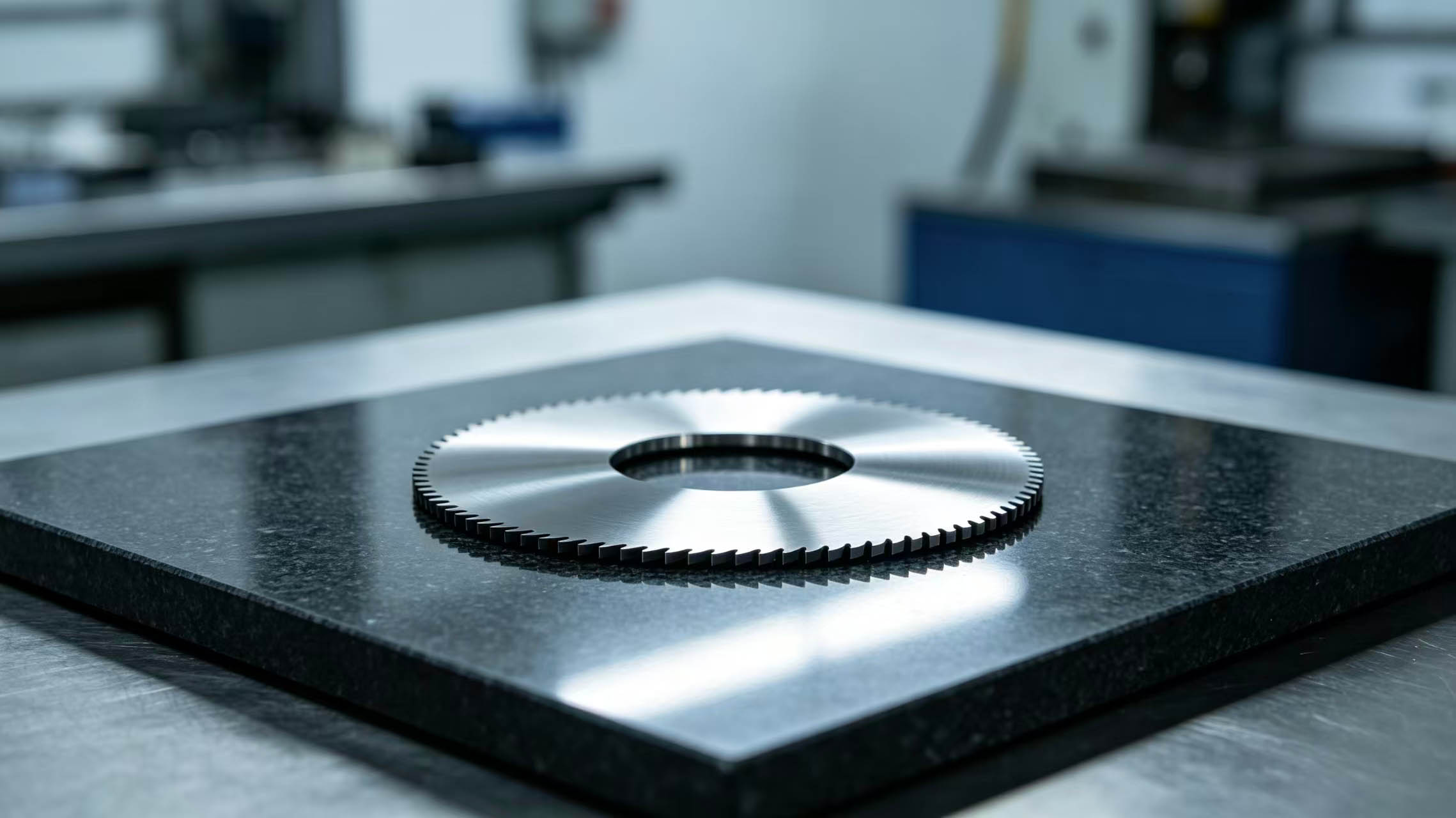
Place the blade flat on a granite surface plate and gently press the four corners with your fingers to feel for any rocking. High precision slitter blade parallelism inspection should show no wobble when pressed by hand. If the blade rocks like a seesaw on the plate, it indicates that parallelism control is inadequate. During shearing, the assembly positioning clearance will be inconsistent in the circumferential direction, easily generating micro-chipping forces, leading to product edge burrs, uneven cuts, curling, and other defects.
2. Check Surface Roughness — The "Revealing Mirror" of Grinding Process
Surface roughness directly reflects the precision of grinding equipment and process level. Slitter blade surface roughness inspection can identify mirror-grade surfaces at Ra0.05-0.1μm. Gently run your fingernail across the blade surface — a high-quality blade should be as smooth as a mirror, with no resistance or roughness.
Tilt the blade and observe under light — a quality blade will have uniform reflection, with no obvious grinding marks, chatter marks, or spiral traces. If the surface shows obvious cross-spiral lines or fish-scale patterns, it indicates poor straightness of the grinding wheel busbar or unreasonable grinding parameters. When roughness fails to meet requirements, the two major faces of the blade tend to adhere to the material being sheared, directly affecting the smooth progress of shearing production.
3. Check the Edge Dark Line — The "ID Card" of Sharpness and Consistency
The edge of a qualified blade should show a fine and uniform dark line, without any chipping, white edges, bright lines, or excessively thick dark lines. This dark line is the micro-land formed after edge grinding, and its uniform width indicates good grinding consistency.
High precision slitter blade edge dark line should be uniform in width, with no breaks or distortions. If the dark line varies in width or appears intermittent, it indicates unstable feed during grinding or untimely wheel dressing. The edge line should be straight, without any bending or deformation.
4. Check Edge Micro-Defects — The Dividing Line Between CNC Grinding and Manual Grinding
Observe the edge with a magnifying glass or microscope — a quality blade should have no chipping, no edge rolling, no burrs, and no micro-cracks. During grinding, due to grinding forces, tiny burrs and micro-gaps appear near the edge, forming micro-serrated edge defects. This is most severe for carbide or powder metallurgy high-speed steel materials.
If the edge shows tiny gaps or serrations under magnification, it indicates the manufacturer lacks a deburring and passivation process. Slitter blade edge micro-defect inspection is essential to remove tiny burrs, smooth the edges of micro-gaps, eliminate micro-serrated edge morphology, and prevent micro-gaps from causing local damage.
5. Check Coating Quality — The "Touchstone" of Surface Treatment
If the blade has a PVD coating (such as golden TiN or purple-black TiAlN), the coating should be uniform without peeling or particle accumulation. A quality coating should have consistent color, with no spots or color differences. Slitter blade coating quality inspection methods should confirm that there is no particle accumulation on the surface or edge, and the coating film should be complete.
Gently scratch the coating surface with a fingernail — a quality coating should be firmly adhered, without peeling or flaking. If the coating shows mottling, peeling, or uneven color, the coating process is substandard. Coating uniformity and adhesion directly affect blade wear resistance and service life.
6. Check Rust Prevention and Packaging — The "Microscope" of Manufacturer Quality Control
Reputable manufacturers apply rust preventive oil before shipment and package each blade individually with rust-proof paper or VCI bags. The bore and outer diameter surfaces undergo blackening treatment to effectively improve rust resistance.
Slitter blade rust prevention packaging check should reveal no rust spots or stains after opening the packaging. If there are fingerprints on the blade surface, it indicates that gloves were not worn during handling, reflecting weak quality control awareness. The packaging method also reveals the manufacturer's attitude — individual separated packaging vs. simple packaging where blades touch each other — the difference is immediately apparent.
7. Check Marking and Traceability Information — The "Business Card" of Management Level
High-quality manufacturers typically use laser engraving on blades to mark material, specifications, batch numbers, and other information. The markings should be clear, centered, and straight, without missing or overlapping prints. Blades with traceability codes indicate that the manufacturer has established a complete quality management system, allowing quality issues to be traced back to specific production batches.
Mingbai Technology's Recommendations
When purchasing slitter blades, don't just look at price and material certificates. Spend three minutes on a "seven-step appearance inspection" — check parallelism, roughness, edge dark line, micro-defects, coating quality, rust prevention packaging, and marking traceability — and you can quickly determine the manufacturer's true process level. Mingbai Mechanical Tool Technology Co., Ltd. focuses on precision manufacturing. Every blade undergoes strict precision and appearance inspection before shipment, giving you "visible" quality and greater peace of mind.
FAQ :
Q1: When purchasing slitter blades, what appearance indicator should be prioritized?A: The most critical indicators are parallelism of the two major faces and uniformity of the edge dark line. Parallelism determines installation stability, and the edge dark line determines cutting consistency. These two indicators best reflect the manufacturer's grinding capability.
Q2: How significant is the difference between Ra0.05μm and Ra0.4μm surface roughness?A: Very significant. Ra0.05μm is mirror-grade — a fingernail glides without resistance and reflection is uniform. Ra0.4μm is ordinary ground surface with visible grinding marks. Higher roughness increases the tendency for the blade to adhere to the material, directly affecting shearing quality and production efficiency.
Q3: What is the edge dark line and how do you inspect it?A: The edge dark line is the micro-land formed after edge grinding, appearing as a fine, uniform dark line under light. A qualified product has a fine, uniform dark line without breaks or white edges. If the dark line varies in width or shows bright reflections, the edge is already worn or unevenly ground.
Q4: How can you judge coating quality on coated blades?A: First, check color uniformity; second, inspect for particle accumulation or peeling spots; third, gently scratch with a fingernail to test adhesion. Quality coatings have pure color, smooth surface, and firm adhesion. Poor coatings often show mottling, color variation, or peeling.
Q5: Why do some blades have fingerprints when opened?A: This indicates that gloves were not worn during handling, reflecting weak quality control awareness. Fingerprint sweat contains salts and fatty acids that can become the starting point for rust during long-term storage. Reputable manufacturers wear gloves throughout cleaning, inspection, and packaging processes.
https://www.mingbaiblade.com/

 Email: Mb@mingbaiblade.com
 Tel.: +86-13855519988


 IPv6 network supported |
Sitemap
|
Xml
|
Privacy Policy
IPv6 network supported |
Sitemap
|
Xml
|
Privacy Policy


 en
en