Circular Blade Coatings (TiN vs TiCN vs TiAlN) — Which Coating Is Suitable for Which Material?
Aug 26, 2026
In circular blade manufacturing, PVD coating technology has become a core means of improving blade performance. TiN, TiCN, and TiAlN are the three most commonly used PVD coatings, but their characteristics, applicable scenarios, and performance differ greatly. Choose the right coating and blade life doubles; choose the wrong one, and the coating peels off prematurely, actually accelerating failure. Mingbai Mechanical Tool Technology Co., Ltd., based on years of coating application experience, provides you with a detailed analysis of the characteristics of these three coatings and their optimal applicable materials.
1. TiN Coating — Golden Classic, General-Purpose Choice
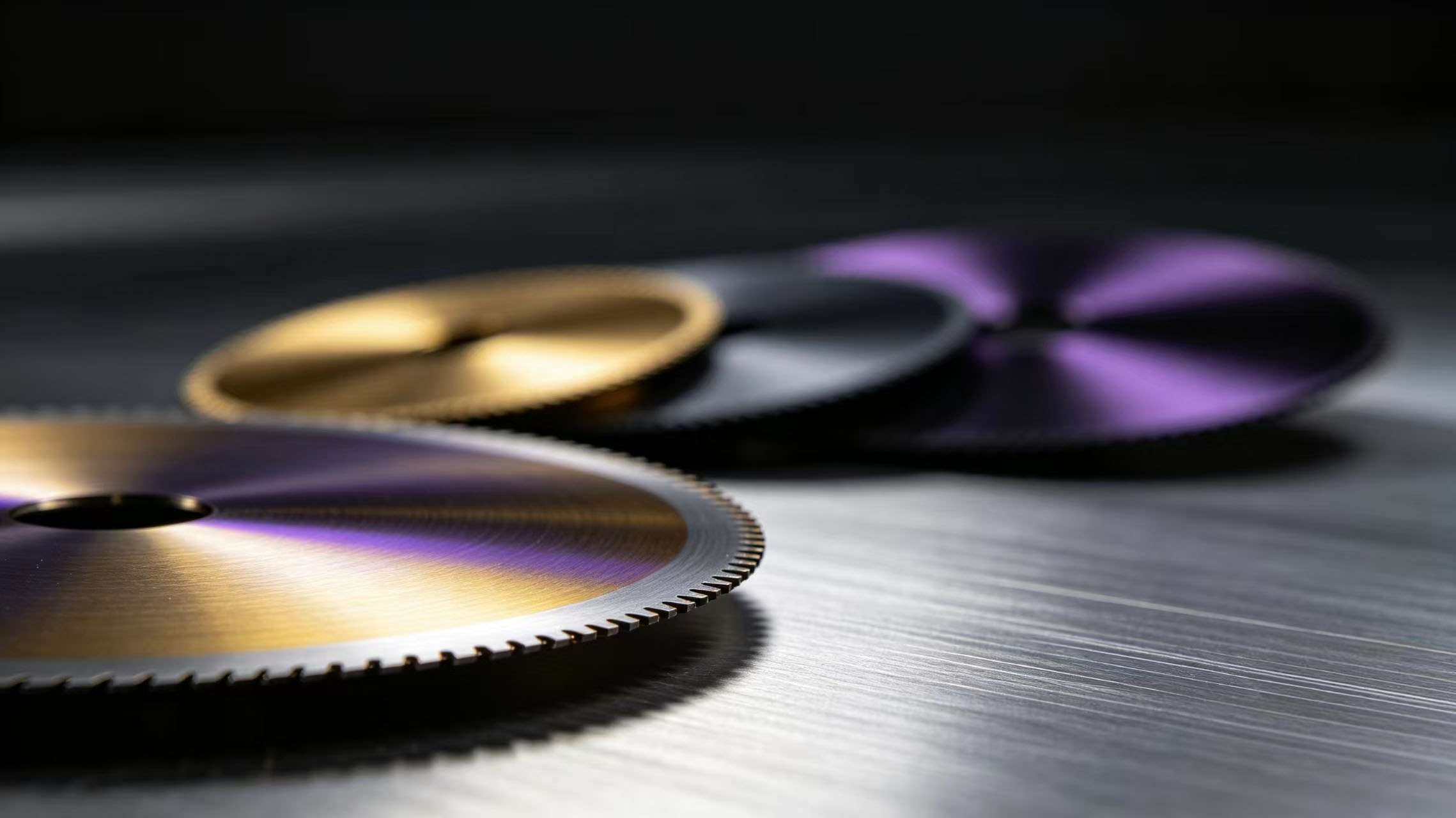
TiN (titanium nitride) is the earliest PVD coating applied to blades, with a golden yellow color, hardness of approximately HV2300, friction coefficient of 0.4-0.6, and temperature resistance of about 600°C. TiN coating offers good versatility and is suitable for most conventional cutting scenarios.
Applicable materials:
· Ordinary carbon steel, alloy steel
· Stainless steel (low-speed cutting)
· Non-ferrous metals such as copper and aluminum
· General machining
Typical products: TiN coated stainless steel blades perform stably in low-speed stainless steel cutting; TiN coated circular blades offer outstanding cost-effectiveness in ordinary carbon steel slitting.
2. TiCN Coating — High Hardness, Wear-Resistant Choice
TiCN (titanium carbonitride) adds carbon to TiN, appearing gray-black or dark gray, with hardness of approximately HV3000-3500, friction coefficient of 0.3-0.4, and temperature resistance of about 400°C. TiCN has higher hardness than TiN and better wear resistance, but slightly lower heat resistance.
Applicable materials:
· High-hardness steel (HRC45-55)
· Cast iron
· Powder metallurgy materials
· Cutting applications with high wear resistance requirements
Typical products: TiCN coated high-speed steel blades have excellent wear resistance in cast iron machining; TiCN coated alloy blades are suitable for high-hardness material slitting.
3. TiAlN Coating — High-Temperature, High-Speed Choice
TiAlN (titanium aluminum nitride) appears purple-black, with hardness of approximately HV3300-3500, friction coefficient of 0.3-0.4, and temperature resistance up to 800-900°C. TiAlN forms an aluminum oxide protective layer at high temperatures, further enhancing heat resistance and anti-adhesion properties, making it the first choice for high-speed cutting and dry cutting.
Applicable materials:
· Stainless steel, titanium alloy
· High-temperature alloys (Inconel, Hastelloy)
· Hardened steel (HRC50-65)
· High-speed cutting (line speed >100 m/min)
Typical products: TiAlN coated carbide blades perform excellently in high-speed stainless steel slitting; TiAlN coated circular blades are suitable for high-temperature alloy processing.
4. Core Parameter Comparison of the Three Coatings
· Hardness: TiAlN ≈ TiCN (HV3300-3500) > TiN (HV2300)
· Temperature resistance: TiAlN (800-900°C) > TiN (600°C) > TiCN (400°C)
· Friction coefficient: TiAlN ≈ TiCN (0.3-0.4) < TiN (0.4-0.6)
· Anti-adhesion: TiAlN > TiCN > TiN
· Versatility: TiN > TiCN > TiAlN
5. Coating Selection Recommendations for Different Materials
Stainless steel slitting: First choice TiAlN coating, high-temperature resistance, anti-adhesion. Second choice TiCN coating, suitable for low-speed conditions.
Ordinary carbon steel slitting: TiN coating offers the best cost-performance ratio and versatility.
High-hardness materials (HRC > 50): TiCN or TiAlN coating, high hardness matches high-hardness materials.
High-temperature alloys, titanium alloys: Must choose TiAlN coating; ordinary coatings will fail quickly at high temperatures.
Non-ferrous metals (copper, aluminum): TiN coating is sufficient, with lower cost.
6. Common Misconceptions in Coating Selection
Myth 1: The harder the coating, the better. High hardness but insufficient toughness leads to peeling under impact conditions.
Myth 2: One coating fits all. Different materials require matching different coating characteristics.
Myth 3: Coating can replace substrate hardness. Coating is only an aid; substrate hardness remains the foundation of life.
7. Mingbai Technology's Coating Services
Mingbai Mechanical Tool Technology Co., Ltd. offers three standard coatings — TiN, TiCN, and TiAlN — as well as special coating customization services such as DLC and AlCrN. Each batch of coated blades comes with coating thickness test reports and adhesion test reports. We can recommend the optimal coating solution for free based on your processing materials, equipment parameters, and life requirements.
Conclusion
TiN is the versatile "all-rounder," suitable for most conventional conditions; TiCN is the high-hardness "wear expert," suitable for high-hardness materials; TiAlN is the "high-temperature warrior," suitable for high-speed and stainless steel processing. Choose the right coating, and blade life doubles. Mingbai Technology is ready to help you achieve cost reduction and efficiency improvement with professional coating solutions.
FAQ :
Q1: Which of the three coatings is the most wear-resistant?
A: TiAlN and TiCN have similar hardness (HV3300-3500), both superior to TiN (HV2300). However, wear resistance also depends on operating temperature — TiAlN performs best at high temperatures, while TiCN may be better at room temperature.
Q2: Can coated blades be resharpened? Will the coating remain after resharpening?
A: Yes, they can be resharpened, but resharpening removes the coating at the edge. It is recommended to recoat after resharpening, or use a solution that allows multiple coatings. Mingbai Technology offers one-stop resharpening + recoating services.
Q3: Why is TiAlN recommended for stainless steel slitting instead of TiN?
A: Stainless steel has poor thermal conductivity and high cutting temperatures. TiN withstands 600°C and softens easily in high-speed stainless steel slitting; TiAlN withstands 800-900°C, forms an aluminum oxide protective layer at high temperatures, has better anti-adhesion, and longer life.
Q4: Is darker coating color always better?
A: No. Color is merely an optical characteristic of the coating material and does not indicate performance. TiAlN appears purple-black because it contains aluminum, which has no direct relationship with performance. Selection should be based on material matching, not color.
Q5: Do the same coatings vary significantly between different manufacturers?
A: Yes, they can vary significantly. Coating performance depends on deposition process, thickness control, adhesion, and other factors. Mingbai Technology uses imported PVD equipment with uniform coating thickness and excellent adhesion, ensuring stable and reliable performance.
Website: www.mingbaiblade.com
 Email: Mb@mingbaiblade.com
 Tel.: +86-13855519988


 IPv6 network supported |
Sitemap
|
Xml
|
Privacy Policy
IPv6 network supported |
Sitemap
|
Xml
|
Privacy Policy


 en
en