Why Do Stainless Steel Blades Always Produce Built-Up Edge at the Cutting Edge During Shearing?
Jul 06, 2026
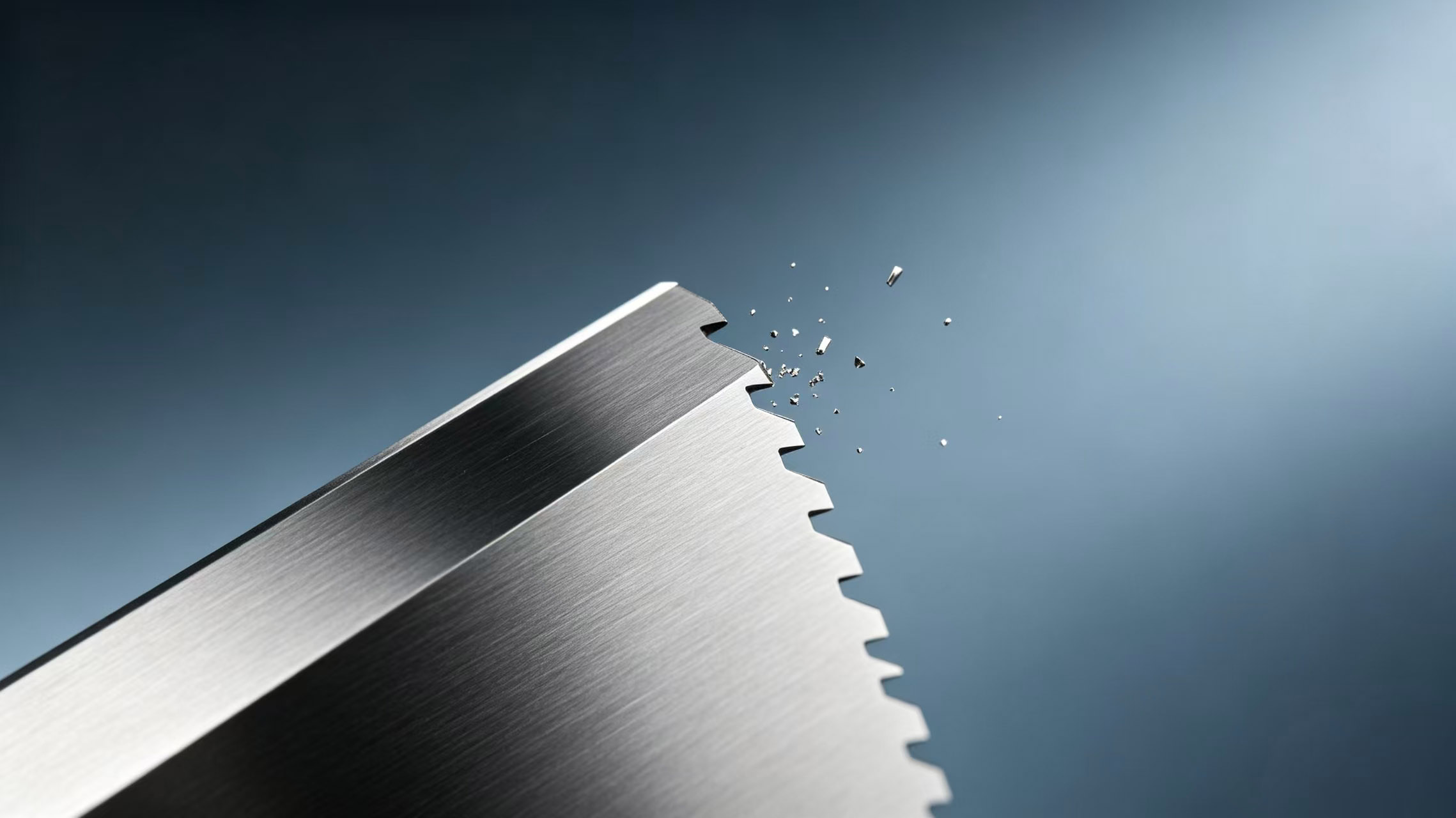
In stainless steel strip slitting operations, a sticky accumulation resembling a "tumor" often appears on the cutting edge of stainless steel blades — this is known as built-up edge. It is formed by tiny metal particles from the sheared material that cold-weld onto the edge surface under high temperature and pressure. Built-up edge not only roughens the cut edge and increases burrs but also accelerates edge wear and, in severe cases, can cause chipping. Mingbai Mechanical Tool Technology Co., Ltd., based on years of stainless steel slitting experience, analyzes the causes of built-up edge and provides solutions.
1. Formation Mechanism of Built-Up Edge
Stainless steel has high toughness, high work-hardening tendency, and low thermal conductivity. During shearing, intense friction occurs between the edge and the material, causing temperatures to rise sharply (locally reaching 500-800°C). Under high temperature and pressure, elements such as chromium and nickel in the stainless steel undergo a "cold welding" effect with the edge surface, and material particles gradually adhere and accumulate, forming built-up edge.
The growth of built-up edge is dynamic: it continuously grows and periodically detaches. When it detaches, it may take away edge material, causing edge defects.
2. Why Is Stainless Steel Particularly Prone to Built-Up Edge?
· High adhesion: The chromium content in stainless steel makes its surface prone to adhesion with blade materials.
· Low thermal conductivity: Heat is concentrated in the edge area, accelerating adhesion.
· Work hardening: The material rapidly hardens during shearing, increasing friction and further raising temperatures.
3. Five Causes of Built-Up Edge Formation
1. Insufficient edge surface finish
The rougher the edge surface, the more microscopic peaks and valleys exist, making it easier for stainless steel particles to "anchor" in the pits and gradually accumulate into built-up edge. Stainless steel blades for precision slitting require edge surface roughness Ra ≤ 0.1μm; otherwise, built-up edge is highly likely to form.
2. Edge angle too small
An excessively small edge angle (<18°) results in insufficient edge strength. During stainless steel shearing, the edge undergoes micro-deformation, increasing contact area with the material and intensifying friction, making built-up edge formation easier. High-speed steel custom blades require an edge angle of 22°-25° for stainless steel slitting.
3. Insufficient lubrication and cooling
Stainless steel slitting requires adequate cooling and lubrication. Insufficient cooling leads to excessive temperatures; insufficient lubrication increases the friction coefficient — both promote built-up edge growth.
4. Improper shearing speed
At low speeds, the material stays at the edge too long, causing heat accumulation; at high speeds, friction heat increases sharply. Each stainless steel grade has its optimal shearing speed window.
5. Mismatched blade coating
TiN coatings tend to adhere to stainless steel during slitting. Wear-resistant coated alloy blades are better suited with TiAlN or AlCrN coatings, which offer superior high-temperature stability and anti-adhesion performance.
4. Three Typical Stages of Built-Up Edge
· Initial stage: Tiny white spots appear on the edge, and fine burrs begin to form on the cut edge.
· Intermediate stage: Built-up edge grows larger, burrs become noticeable, and the cut surface becomes rough.
· Advanced stage: Built-up edge detaches, taking edge material with it, resulting in chipping.
5. Six Effective Measures to Eliminate Built-Up Edge
1. Improve edge surface finish
Polish the edge surface to Ra ≤ 0.05μm to reduce microscopic anchoring points. Mirror-polished stainless steel blades are highly effective in high-end slitting applications.
2. Optimize edge angle
Recommended edge angle for stainless steel slitting: 22°-25°, clearance angle 8°-10°, with micro-passivation (R=0.01-0.02mm).
3. Select the appropriate coating
TiAlN or AlCrN coatings offer excellent anti-adhesion properties, reducing built-up edge formation. High-hardness wear-resistant coated circular blades perform excellently in stainless steel slitting.
4. Optimize cooling and lubrication
Use stainless steel-specific cutting fluid, ensure nozzles are aimed at the cutting entry zone, and maintain sufficient flow (oil mist lubrication 10-20ml/h recommended).
5. Adjust shearing speed
Recommended speeds: 80-120m/min for 300 series stainless steel, 60-100m/min for 400 series; fine-tune according to specific grades.
6. Regularly inspect the edge
Inspect the edge during each shift change. If early signs of built-up edge are found, clean them promptly to prevent severe adhesion.
6. Mingbai Technology's Anti-Adhesion Solutions
Mingbai Mechanical Tool Technology Co., Ltd. offers a dedicated blade series for stainless steel slitting:
· Anti-adhesion stainless steel slitting blades: featuring mirror polishing + PVD AlCrN coating
· Edge surface roughness Ra ≤ 0.05μm
· Optional micro-lubrication system for optimal lubrication
· Edge condition inspection services to monitor built-up edge development
7. Case Study
A precision stainless steel strip slitting plant used ordinary alloy blades to slit 304 stainless steel. Visible built-up edge appeared on the edge every 2 hours, and cut edge burrs exceeded tolerance. After switching to Mingbai Technology's anti-adhesion stainless steel slitting blades, the time before built-up edge appeared extended to 12 hours, blade life increased by 3 times, and cut edge quality remained stable.
Conclusion
The root cause of built-up edge formation when shearing with stainless steel blades lies in the high adhesion characteristics of stainless steel and the microstructure of the edge surface. Effective control requires a multi-pronged approach: improving surface finish, optimizing angles, selecting suitable coatings, and improving lubrication. Mingbai Technology is ready to help you eliminate built-up edge problems with professional stainless steel slitting blade solutions.
Website: www.mingbaiblade.com

 Email: Mb@mingbaiblade.com
 Tel.: +86-13855519988


 IPv6 network supported |
Sitemap
|
Xml
|
Privacy Policy
IPv6 network supported |
Sitemap
|
Xml
|
Privacy Policy


 en
en