Home

special-shaped blades

special-shaped blades

  • Can I Only Provide an Old Blade Sample for Custom Blades? What Should I Pay Attention To?
    Jun 03, 2026
    Many customers, when needing to reorder custom blades, only have a worn old blade on hand and no original drawing. They often ask: can I only provide an old blade sample for an exact replication? The answer is: yes, but there are several key details to pay attention to. Mingbai Mechanical Tool Technology Co., Ltd., based on numerous "sample-based customization" cases, outlines the operational points and precautions for you.   1. Providing Only an Old Blade Sample Is Feasible   As long as the old blade is not severely deformed, chipped, or corroded, Mingbai Technology can use reverse engineering measurement technology to accurately restore its geometric dimensions and edge parameters. We use coordinate measuring machines and profilometers to capture key feature points of the blade and generate manufacturing drawings. This method is particularly suitable for reproduction of old blades without drawings, saving customers the trouble of re-measuring themselves.     2. Six Details to Pay Attention to When Providing an Old Blade Sample   1. Confirm whether the sample is representative   If you have multiple old blades of the same specification, it is recommended to choose the one with the least wear and no obvious deformation as the sample. Choosing the sample with the least wear improves reverse engineering accuracy. If all blades are severely worn or chipped, it is better to provide a new blade sample or contact the original manufacturer for drawings.   2. Clean the sample surface     Before sending, be sure to thoroughly clean the surface of the old blade with alcohol or cleaner to remove oil, rust, and adhered material. Residual dirt will affect measurement accuracy, especially for small features on the edge area.     3. Mark the edge direction and mounting surface   Use a marker pen or label to mark the edge direction and mounting surface on the old blade to avoid confusing the front and back during reverse engineering. For circular blades or slitter blades with asymmetrical edges, this is especially important.     4. Provide supplementary operating condition information   Relying only on the old blade sample, the manufacturer cannot know the material, thickness, equipment type, etc. It is recommended that you provide the grade and thickness of the material being slit, as well as the equipment speed and tension range. This information helps Mingbai engineers determine whether the original blade design was reasonable and optimize parameters if necessary.   5. Indicate whether you accept optimization suggestions   The design of an old blade may not be optimal. Mingbai Technology may propose edge angle or coating optimization solutions based on your operating conditions. If you want an exact 1:1 replica, you must clearly state this; if you are willing to accept optimization, please also indicate that.   6. Package with shock and damage protection   The old blade itself may have fragile chipped areas. When sending, it should be individually wrapped with foam or air cushion bags to avoid secondary damage from collisions during transport.   3. Standard Process for Reverse Engineering Customization   Step 1: Customer sends the old blade sample, along with operating condition descriptions and replication requirements. Step 2: Mingbai laboratory performs 3D scanning or coordinate measurement to generate CAD drawings.     Step 3: Confirm drawing parameters (outer diameter, bore, thickness, edge angle, etc.) with the customer. Step 4: Produce according to the drawings, conduct first-article inspection, then deliver in batches. Step 5: Return the old blade sample with the shipment.   4. Situations Where Providing Only a Sample Is Not Suitable   · The blade is severely deformed (flatness > 0.1mm) · The edge has large-area chipping (> 1mm) · The blade surface is severely corroded with lost features · The original blade design itself is unreasonable (e.g., wrong material, angle too small)   In the above cases, it is recommended that Mingbai engineers redesign rather than blindly copy.   5. Mingbai Technology's Advantages in Reverse Engineering Customization   Mingbai Mechanical Tool Technology Co., Ltd. has high-precision coordinate measuring machines and profilometers capable of reverse engineering of complex special-shaped blades with accuracy up to ±0.002mm. We promise:   · 1:1 replication, dimensions perfectly matched · Free drawing confirmation provided · Old blade samples properly kept and returned · Support for material upgrades (e.g., upgrading ordinary steel to alloy blades or stainless steel blades)     6. Customer Case   A packaging machinery factory ran out of circular blades for film cutting because the original manufacturer had discontinued production. The customer sent a worn old blade. Mingbai Technology performed reverse engineering and produced 50 blades. After installation, the cutting performance was exactly the same as the original, solving the customer's urgent problem.   Conclusion   Providing only an old blade sample to customize custom blades is completely feasible, but you need to pay attention to six details: sample selection, cleaning, marking, and information supplementation. Mingbai Mechanical Tool Technology Co., Ltd. is willing to use its professional reverse engineering technology to help you solve the problem of "having a sample but no drawing." Website: www.mingbaiblade.com
  • Types of packaging machine blades and selection suggestions
    Jan 26, 2026
    Packaging machine blades are one of the core components in packaging equipment, and their performance directly affects packaging quality, production efficiency, and equipment life. As an indispensable cutting tool in the packaging production line, choosing the right blade is crucial for the stable production of enterprises. This article will provide you with a detailed introduction to the main types of packaging machine blades and provide practical selection suggestions to help you make better decisions.   The main types of packaging machine blades 1. Split blades Split blades consist of a combination of a tool holder and a knife bar and are often used in cutting scenarios that require frequent replacement or adjustment. The advantage is that the knife bar can be replaced individually, reducing the cost of use while facilitating maintenance and adjustment. It is suitable for conventional cutting of packaging materials, such as cartons, films, etc. 2. Integral blades The integral blade adopts a one-piece molding design, with a stable structure and strong rigidity, suitable for continuous cutting operations at high speed and high load. This type of blade is commonly used for heavy-duty packaging materials or cutting processes that require high precision, such as thick woven bags, rubber plates, etc. 3. Circular blades The circular blade completes the cutting by rotation and is suitable for continuous slitting or fixed-length cutting of coils. Its cutting process is smooth and neat, and it is widely used for horizontal or longitudinal slitting of film, paper, flexible packaging and other materials. 4. Shaped blades Blades customized according to special packaging shape needs, such as zigzag, wavy, etc. Special-shaped blades can achieve special cutting effects and are often used in gift packaging, food packaging, and other occasions that require aesthetic or functional cuts. 5. Alloy blades Made of high-performance materials such as carbide, it has excellent wear and corrosion resistance and has a long service life. Ideal for cutting abrasive materials or production environments where blade life is highly demanding. 6. Custom blades Non-standard inserts designed for special models, special materials or special process requirements. Custom blades can perfectly match equipment and production needs to solve special cutting challenges.   How to choose the right packaging machine blade? 1. Choose according to the packaging material · Soft materials (e.g., film, plastic bags): Choose blades with high sharpness and smooth surfaces, such as integral flat or round blades. · Hard/thick materials (e.g., cardboard, woven bags): Require a rigid blade, such as a thick monolithic knife or alloy blade. · Composite or Special Coating Materials: Consider wear-resistant, non-stick coated blades or alloy inserts. 2. Choose according to the cutting requirements · Normal straight cut: Standard split or monolithic blades are sufficient. · High-Speed Continuous Cutting: Prioritize monolithic or alloy blades for stability. · Precision cutting or special-shaped cutting: Customized high-precision blades or special-shaped blades are required. 3. Match according to the device model Different packaging machine brands and models have specific requirements for blade size, installation method, aperture, etc. When choosing, be sure to confirm the compatibility of the blade with the equipment or contact the manufacturer for a customized adaptation solution. 4. Comprehensive Consideration of Cost and Lifespan · Short-term or low-frequency use: Economical split blades can be selected. · Long-term high-frequency production: It is recommended to invest in integral or alloy blades. Although the initial cost is higher, their longer lifespan makes them more cost-effective overall. 5. Focus on Maintenance and Upkeep Regardless of the type of blade chosen, regular maintenance (such as sharpening, cleaning, and lubrication) can significantly extend its lifespan. Choosing a blade design that is easy to maintain can also reduce long-term operational costs.   Mingbai Technology's Professional Solutions As a professional machinery tool manufacturer, Mingbai Technology not only offers a full range of products including split blades, integral blades, circular blades, special-shaped blades, alloy blades, and customized blades, but also provides one-on-one selection advice and customization services based on customers’ equipment models, material characteristics, and production needs. We use high-quality steel and advanced heat treatment processes to ensure the sharpness, wear resistance, and stability of every blade, helping you improve packaging quality and reduce production costs. If you still have questions about choosing packaging machine blades or need blades customized to special specifications, feel free to contact Mingbai Technology at any time. We will provide you with professional technical support and solutions. https://www.mingbaiblade.com/
  • Common applications of special-shaped blades in industrial manufacturing
    Jan 22, 2026
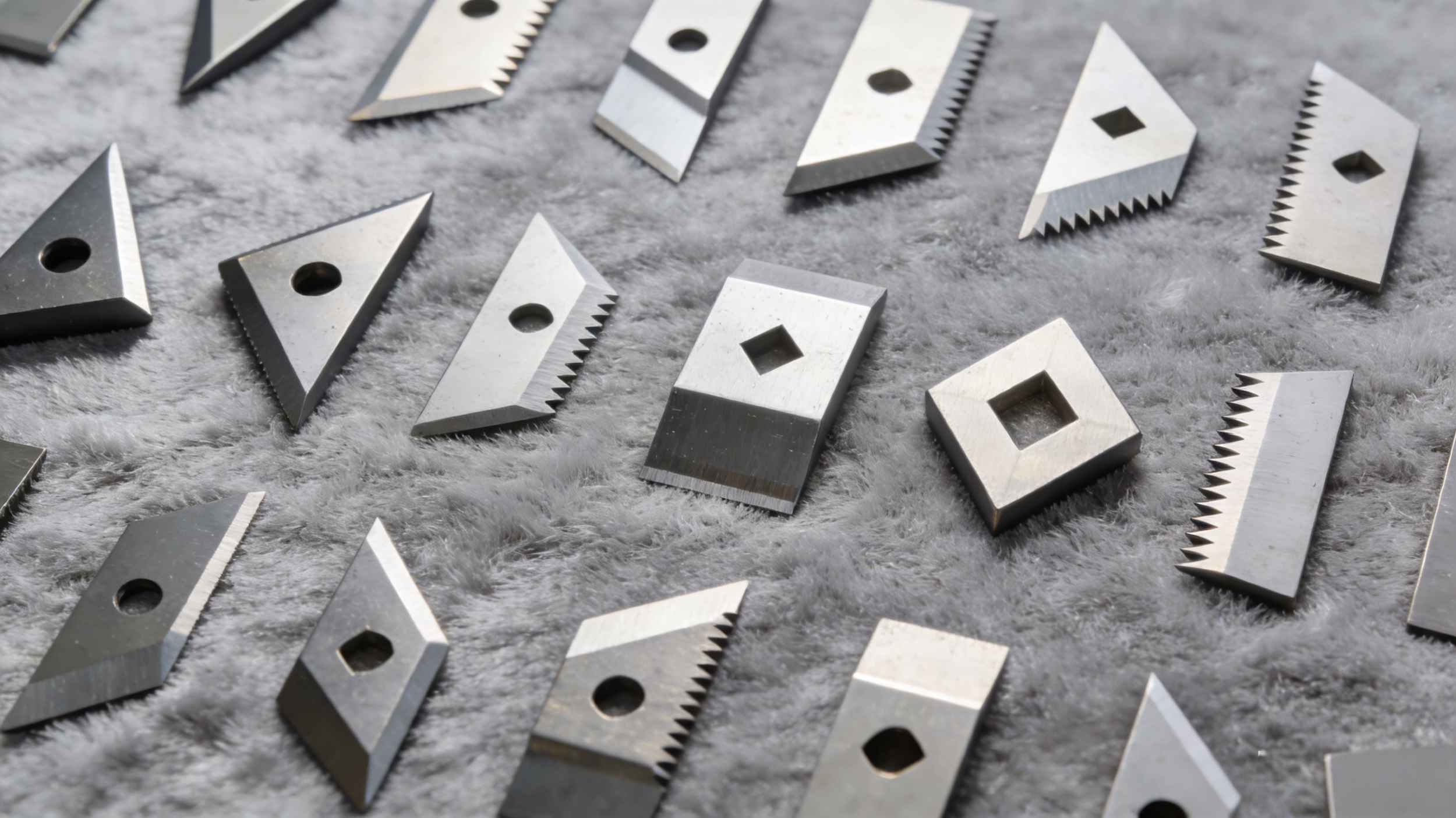
    In the field of precision machining and material forming, the shape and performance of the blade directly determine the quality and production efficiency of the product. As a non-standard, special-shaped tool designed for specific machining needs, is playing a key role in more and more industrial scenarios due to its flexible design and efficient machining capabilities. Today, we will introduce the common applications of special-shaped blades in industrial manufacturing and how they can help enterprises achieve precision machining, reduce costs and increase efficiency.   What is a profiled blade? Special-shaped blades, as the name suggests, refer to blades whose shape is not limited to conventional round, square, or rectangular shapes, but is individually designed according to the shape of the processed material, cutting trajectory, or special process requirements. These blades usually have special edge shapes, angles, or structures that can perform tasks such as cutting, stamping, slitting, and trimming that are difficult to achieve with ordinary blades.   The main application areas of special-shaped blades 1. Packaging and printing industry In the paper, flexible packaging and printing industries, special-shaped blades are commonly used in die-cutting processes. For example, when making products such as gift boxes, cartoon labels, and special-shaped trademarks, it is necessary to customize the blade shape according to the design drawings to achieve one-time forming and cutting, with smooth edges and no burrs, which greatly improves product aesthetics and production efficiency. 2. Metalworking and sheet metal industry In sheet metal stamping, auto parts manufacturing, and metal decoration processing, special-shaped inserts can be used to punch parts with special contours, such as gear plates, motor cores, heat sinks, etc. Its high hardness and high wear resistance ensure dimensional stability during long-term machining, reducing the frequency of tool changes.   3. Textile and leather cutting  For clothing, shoe materials, bags and other industries, special-shaped blades can efficiently complete curve cutting, hollowing, punching and other processes, especially suitable for automatic cutting equipment, to achieve one-time precise cutting of multi-layer materials, save raw materials and improve consistency. 4. Food processing equipment In the food industry, special-shaped blades are commonly used to cut products such as biscuits, pastries, noodles, meat, etc., forming patterns, wavy shapes, or specific shapes. Food-grade materials and precision cutting edge design not only meet hygiene requirements, but also ensure beautiful cutting results. 5. Rubber and plastic molding Used for cutting rubber seals, silicone products, plastic accessories, etc., the special-shaped blade can be customized according to the shape of the product section, achieving efficient and continuous cutting, and the cut is flat and not easy to deform.   Why choose custom-shaped blades? Every industry, piece of equipment, and type of material may have unique blade requirements. Standardized blades often cannot fully meet these specialized process needs, while custom-shaped blades offer the following advantages: · Precise fit: Designed specifically according to equipment parameters and processing materials to enhance cutting accuracy and product consistency. · Improved efficiency: Optimized cutting paths and edge angles to reduce processing steps and time. · Extended lifespan: Selecting the right materials and heat treatment processes to enhance wear resistance and toughness, thereby reducing production costs. · Solve special challenges: Providing professional solutions for cutting composite materials, ultra-thin materials, and high-hardness materials.   Our Expertise Mingbai Machinery Tool Technology Co., Ltd. focuses on the research, development, and custom production of various mechanical blades, with extensive experience in custom-shaped blades. We can professionally design and manufacture blades based on customer-provided drawings or samples, ensuring that the blades fully meet the practical production requirements in terms of strength, precision, and durability. Whether it is rotary shear blades, circular blades, or complex-shaped custom blades, we can provide reliable solutions for you. If you have custom-shaped blade needs or related technical inquiries, feel free to contact us at any time. Mingbai Technology is dedicated to providing you with professional support and solutions. https://www.mingbaiblade.com/

Leave A Message
If you are interested in our products and want to know more details,please leave a message here,we will reply you as soon as we can.
submit

leave a message

leave a message
If you are interested in our products and want to know more details,please leave a message here,we will reply you as soon as we can.
submit

home

products

WhatsApp

Contact Us