Home

Circular blades for precision slitting

Circular blades for precision slitting

  • After Long-Term Storage, Rust Spots Appear on the Cutting Edge of Circular Blades — Will This Affect Performance?
    Jul 28, 2026
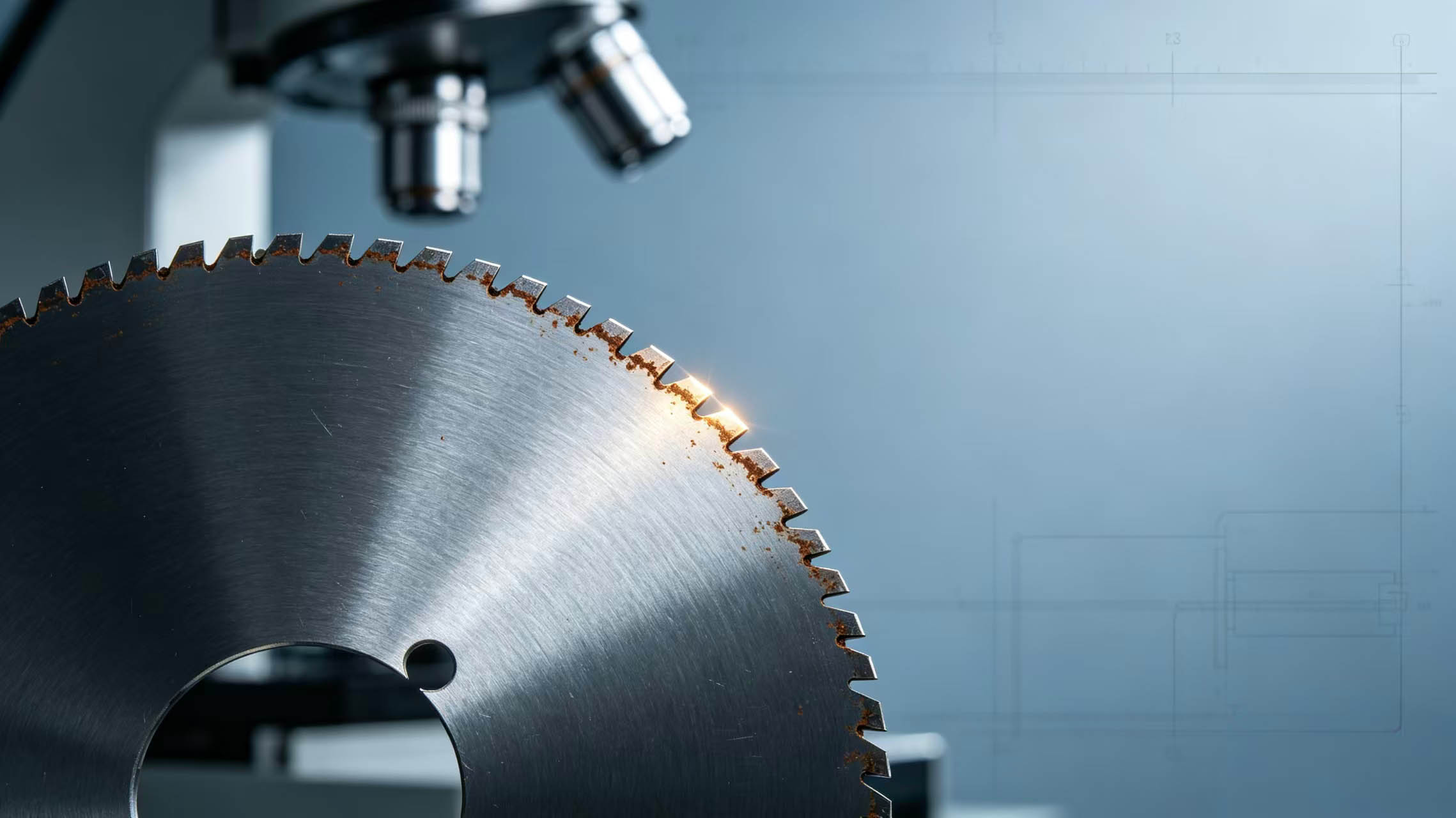
    In slitting production, many users retrieve circular blades from long-term warehouse storage and find yellowish-brown rust spots on the cutting edge. When faced with rust spots, the most common concern is: do these rust spots affect cutting performance? Can the blade still be used? Mingbai Mechanical Tool Technology Co., Ltd., based on materials science and field experience, provides scientific judgment criteria and handling recommendations.   1. The Nature and Hazards of Rust Spots   Rust spots are the product of electrochemical reactions between the blade's metal surface and oxygen and moisture in the air. For precision mechanical blades made of high-carbon steel, high-speed steel, and similar materials, once rusting begins, it penetrates from the surface inward. The harm of rust spots depends on three factors: location, depth, and morphology.   2. Three Types of Rust Spots on the Cutting Edge     Surface flash rust (mild) Characteristics: Yellowish-brown powdery rust, present only on the surface, depth < 0.01mm, removable with a cloth. Impact: After removal, no visible pits remain on the edge — does not affect performance.   Pitting rust (moderate) Characteristics: Dark brown or black spots, depth 0.01-0.03mm, leaving tiny pits the size of a pinprick after removal. Impact: May affect cutting quality, depending on specific working conditions.   Pitted/crater rust (severe) Characteristics: Dark brown or black depressions, depth > 0.03mm, leaving obvious pits or grooves after removal. Impact: Significantly affects performance, causing burrs or chipping during cutting — replacement is recommended.   3. Four-Step Method to Determine Whether Rust Spots Affect Performance   Step 1: Check the rust spot location   Rust spots on the cutting edge → directly affect cutting quality and require careful handling. Rust spots on the blade body (non-edge areas) → do not affect performance; clean and use. Inspection method for rust spots on stored circular blades starts with location.     Step 2: Assess rust spot depth   Gently sand the rusted area with fine sandpaper or an oilstone. If the surface is flat without pits after sanding → flash rust, can continue to be used. If obvious pits remain → rust has penetrated the substrate; assess whether edge integrity is compromised.     Step 3: Check edge integrity   Use a magnifying glass to inspect the edge. If the edge remains straight and intact → rust has not damaged the edge geometry. If the edge appears jagged or has notches → rust has damaged the edge, and circular blades for precision slitting will directly affect cutting accuracy.     Step 4: Verify through trial cutting   After cleaning the rust, perform a trial cut. Smooth cut edge without burrs → performance restored. Obvious burrs or uneven edges → rust has affected performance; recommend replacement or return to factory for regrinding.     4. Rust Tolerance of Different Blade Materials   High-speed steel circular blades: Most sensitive to rust. Pitting deeper than 0.02mm is recommended for replacement.   Carbide blades: The substrate does not rust, but the cobalt binder phase may corrode; edge strength must be checked.   Stainless steel blades: Good corrosion resistance. Rust spots usually stay on the surface with shallow depth. Ultra-thin circular blades for food packaging film slitting are more sensitive to defects and require special attention.   Coated blades: Rusting tends to occur where the coating is damaged; confirm whether rust has penetrated the coating.   5. Rust Removal Methods   Flash rust removal Gently sand with a fine oilstone (1000 grit or higher) with oil, or lightly brush with a brass wire brush, then wipe with rust preventive oil for protection.   Moderate rust removal Sand with fine sandpaper (800-1200 grit) until the surface is bright, taking care not to alter the edge geometry. Then inspect edge integrity with a magnifying glass.   Deep rust treatment Directly scrap, or send back to Mingbai Technology for evaluation to see if it can be restored through regrinding. If the edge is intact after regrinding, it can continue to be used.   6. How to Prevent Rust Spots in Storage?   · Control storage environment humidity between 40%-60%. · Long-term stored custom slitter blades should be coated with rust preventive oil and vacuum-packed. · Regularly inspect inventory, spot-check every 3 months. · Store blades of different materials separately to avoid galvanic corrosion.     7. Mingbai Technology's Rust Inspection Services   Mingbai Mechanical Tool Technology Co., Ltd. offers rust evaluation for stored circular blades services:   · Free visual inspection to determine rust type and depth. · Microscope inspection of edge integrity. · Provide repair or replacement recommendations. · Professional rust removal and regrinding services for repairable blades.   Conclusion   Rust spots on the cutting edge of circular blades after long-term storage do not necessarily mean the blade is scrap. Surface flash rust can be cleaned and does not affect performance. Pitting rust requires assessment of location and depth. Pitted/crater rust or edge damage should be scrapped or sent back for repair. The key steps are: "check location, measure depth, inspect edge, verify through trial cutting." Mingbai Technology is ready to provide professional rust inspection and repair services for you. Website: www.mingbaiblade.com
  • When Customizing Blades, Why Is There Always a Deviation Between the "Edge Angle" Marked on the Drawing and the Actual Machined Result?
    Jul 13, 2026
    When customizing custom blades, circular blades, or slitter blades, many customers encounter a puzzling problem: the edge angle is clearly marked on the drawing, but the actual machined blade always deviates from the drawing when measured. Is it due to insufficient machining precision on the manufacturer's side? Or is there a problem with the drawing itself? Mingbai Mechanical Tool Technology Co., Ltd., based on years of production experience, explains six common causes of angle deviation.   1. Different Measurement References — The Angle on the Drawing and the Actual Measured Angle Are Not the Same "Angle"   The edge angle is a three-dimensional geometric concept. The angle marked on the drawing is usually a theoretical value measured on a specific cross-section, such as a plane perpendicular to the edge direction. However, during actual measurement, if the measurement direction, cross-section position, or measuring instrument differs, the obtained values will vary.   For example, for circular blades for precision slitting, the edge angle is measured on the normal cross-section at the highest point of the edge. If the measurement is offset by 0.5mm, the angle can differ by 1°to 2°.   2. The Effect of Edge Radius (Passivation Value)   The edge angle marked on the drawing usually assumes an ideal sharp edge (R=0). In reality, all blades have a certain edge radius after grinding. Alloy blades for high-speed slitting are often micro-passivated (R=0.01-0.02mm), and this passivation makes the actual measured "apparent angle" slightly larger than the theoretical angle.     3. Thermal Deformation During Grinding   Grinding generates heat, causing localized temperature rise and metal expansion. After cooling, the blade contracts, but the contraction amount varies across different areas, potentially causing minor changes in the edge angle. Ultra-thin mechanical blades are particularly sensitive to thermal deformation; even with adequate cooling during grinding, deviations of 0.5° to 1° can still occur.   4. Grinding Wheel Wear and Dressing Frequency   In batch production, the grinding wheel gradually wears. If not dressed in time, the wheel's shape changes, causing the ground edge angle to drift accordingly. Wear-resistant circular blades for stainless steel strip slitting require extremely high angle consistency, and accumulated angle deviation due to wheel wear can reach ±1.5°.     5. Measuring Instrument Precision and Calibration   Different measuring instruments have different precision and calibration status. Measuring the same blade's edge angle with a projector, tool microscope, or profilometer can yield differences of 0.5° to 1°. If instruments are not regularly calibrated, the deviation is even larger.     6. Incomplete Drawing Specifications   Many drawings only specify "edge angle 30°" without indicating whether it is the wedge angle, rake angle, or clearance angle, nor do they specify the measurement cross-section, tolerance range, or edge radius requirements. For high-hardness custom blades, if the edge angle lacks a tolerance specification, the manufacturer will follow default standards such as ±2°, which may deviate significantly from the customer's expectations.   7. How to Avoid Angle Deviation? — Five Suggestions   1. Complete drawing specifications Clearly specify the values of wedge angle, rake angle, and clearance angle; indicate the measurement cross-section position; specify the angle tolerance (recommended ±0.5°); and state the edge radius requirements.   2. Agree on measurement method Confirm with the manufacturer what instrument will be used and at what cross-section position the measurement will be taken, ensuring both parties have a consistent understanding of "angle."   3. Request first-article inspection Before mass production, ask the manufacturer to provide a first-article inspection report to confirm the angle meets requirements before proceeding with batch production.   4. Choose a manufacturer with CNC grinding capability CNC grinders can precisely control the grinding wheel path, keeping angle deviation within ±0.3°.   5. Consider grinding allowance For custom slitter blades, you may specify "grinding allowance 0.1-0.2mm" on the drawing to allow for final precision grinding and angle adjustment.   8. Mingbai Technology's Angle Control Capability   Mingbai Mechanical Tool Technology Co., Ltd. uses five-axis CNC grinders, achieving edge angle control precision of ±0.3°. Every precision mechanical blade is inspected with a profilometer before shipment, and an angle inspection report is provided. We guarantee that the deviation between the drawing-specified angle and the actual machined angle is ≤±0.5° (and can be controlled within ±0.3° for special cases).   Conclusion   The deviation between the edge angle marked on the drawing and the actual machined result can stem from multiple factors: measurement reference, edge radius, thermal deformation, wheel wear, instrument precision, or incomplete drawing specifications. As long as both parties agree on specification, measurement, and inspection, the deviation can be controlled within an acceptable range. Mingbai Technology is committed to precision manufacturing, ensuring your drawing and the actual product match "angle for angle." Website: www.mingbaiblade.com

  • When Slitter Blades Produce Sharp Noise During Cutting, Is It a Blade Problem or an Equipment Problem?
    Jun 30, 2026
    In metal slitting operations, a sudden sharp, piercing noise from slitter blades during cutting is an alarming signal. Such noise not only affects the working environment but also often indicates potential issues with the blade or equipment. Many operators struggle to identify the source of the noise, blindly replacing blades or stopping production for inspection, which wastes time and increases costs. Mingbai Mechanical Tool Technology Co., Ltd., based on extensive on-site diagnostic cases, helps you quickly determine: does the sharp noise come from the blade or the equipment?   1. Two Typical Sources of Sharp Noise     1. High-frequency continuous screeching sound (similar to metal scraping)   This sound is continuous, sharp, and usually related to the rotational frequency of the blade or blade shaft. Common causes:   · Blade gap too small, upper and lower edges rubbing against each other · Insufficient lubrication, dry friction between blade and material · Edge clearance angle too small, excessive contact area between blade body and material · Blade surface roughness too high, resulting in high friction coefficient   2. Periodic impact sound (similar to a "click" or "clack")   This sound occurs rhythmically, once or several times per revolution. Common causes:   · Blade edge has chipping; the chipped area impacts the material during rotation · Blade or blade shaft eccentricity, producing an impact each revolution · Excessive clearance between blade bore and blade shaft, causing the blade to wobble on the shaft   2. Three-Step Diagnosis: Blade or Equipment?   Step 1: No-load test     Remove the material and let the slitter blades run at no load. If the noise disappears → the problem lies with the material or cutting parameters. If the noise persists → the problem lies with the blade or equipment.   Step 2: Exchange test   Move the noisy circular blade to another normal machine and run it. If the noise follows the blade → the problem is with the blade itself. If the noise stays with the original machine → the problem is with the equipment.   Step 3: Component-by-component inspection   · Remove the blade and rotate the blade shaft alone; listen for abnormal bearing noise. · Check blade shaft runout (measure with a dial indicator; radial runout should be ≤0.005mm). · Check blade gap (measure with a feeler gauge; should be 5%-10% of material thickness).   3. Blade-Related Noise Issues   1. Edge chipping   Circular blades for stainless steel strip slitting may develop tiny edge chips when encountering hard spots in the material. When the chipped area rotates into contact, it impacts the material, producing a periodic "clack" sound.     2. Uneven edge wear   Alloy blades for silicon steel slitting are prone to localized wear bands due to the hardness of the material. The alternating contact of worn and unworn areas with the material produces a periodic screeching sound.   3. Coating peeling   After the PVD coating of high-speed slitter blades peels off, the exposed substrate has a higher friction coefficient with the material, generating a continuous screeching sound.   4. Blade deformation   Ultra-thin circular blades may develop end face warpage during heat treatment or use, causing the edge trajectory to become wavy during rotation and producing high-frequency noise.   4. Equipment-Related Noise Issues   1. Bearing damage   When spindle bearings are worn or pitted, the rolling elements passing over damaged areas produce high-frequency vibration and screeching, intensifying with increasing speed.     2. Bent blade shaft   A slightly bent blade shaft creates a radial impact once per revolution, producing a rhythmic impact sound.   3. Excessive gear backlash   Worn transmission gears with increased backlash produce impact noise during gear meshing under cutting loads.   4. Lubrication system failure   Insufficient lubricant or blocked oil passages cause bearings and gears to run under dry conditions, producing metal-on-metal screeching sounds.   5. Solutions   Blade issues:   · Chipping or wear → return to factory for resharpening or replacement. · Coating peeling → recoat or replace with custom slitter blades. · Deformation → check flatness; scrap if out of tolerance.   Equipment issues:   · Bearing damage → replace spindle bearings and inspect the blade shaft. · Bent blade shaft → straighten or replace. · Lubrication system → clean oil passages and replace lubricant.   6. Mingbai Technology's Diagnostic Services   Mingbai Mechanical Tool Technology Co., Ltd. offers noise diagnostic services:   · Free remote audio diagnosis (record the equipment running sound and send it to us). · On-site vibration testing using a vibration meter to capture spectrum data. · Issue a diagnostic report clearly identifying the noise source and providing solutions. · Provide noise reduction recommendations (gap adjustment, lubrication improvement, blade selection).     7. Case Study   A stainless steel strip slitting plant experienced a sharp, continuous piercing noise from circular blades for precision slitting during cutting. The customer tried blades from three different suppliers, but the noise persisted. Mingbai engineers inspected on-site and found that the radial clearance of the lower blade shaft bearing was 0.08mm (standard ≤0.02mm), and the bearing cage had fractured. After bearing replacement, the noise completely disappeared.   Conclusion   When slitter blades produce sharp noise during cutting, it could be a blade problem or an equipment problem. Use the three-step method of "no-load test + exchange test + component-by-component inspection" to quickly locate the source. Mingbai Technology is ready to help you eliminate noise and restore smooth production with our professional diagnostic capabilities. Website: www.mingbaiblade.com
  • Can Poor Dynamic Balance of Slitter Blades Damage the Equipment Spindle?
    Jun 22, 2026
    The answer is: Yes, and the consequences are more serious than you might imagine. Many slitting plants focus only on blade material and edge sharpness, but overlook the critical indicator of dynamic balance. Slitter blades with poor dynamic balance generate centrifugal forces during high-speed operation that act like "high-frequency hammering" continuously impacting the spindle bearings. Over time, this leads to loss of spindle precision, bearing damage, and even complete machine failure. Mingbai Mechanical Tool Technology Co., Ltd. provides a detailed analysis of the hazards of poor dynamic balance and their solutions.   1. How Does Poor Dynamic Balance Damage the Spindle?     When a high-speed slitter blade has a mass eccentricity, it generates a centrifugal impact with each revolution. At 300 RPM, this equates to approximately 430,000 impacts per day; at 1000 RPM, the number of daily impacts reaches as high as 1.44 million.   These impacts are transmitted through the blade shaft to the spindle bearings, causing:   · Bearing pitting: Small pits form on rolling elements and raceways under micro-impacts, gradually increasing vibration levels. · Cage fracture: High-frequency alternating stress leads to fatigue fracture of the bearing cage. · Spindle bending: Long-term unilateral force causes permanent bending deformation of the spindle. · Blade shaft wear: Fretting wear at the shaft-bearing interface creates clearance.   2. Four Typical Symptoms of Poor Dynamic Balance     1. Spindle vibration levels continuously rise: Vibration velocity (RMS) measured with a vibration meter increases from the normal 1.0mm/s to above 3.0mm/s. 2. Abnormal blade wear: The edge shows "wavy" wear patterns, with circular blades for precision slitting wearing significantly faster in certain areas. 3. Declining product accuracy: Slitting width fluctuations increase, and burrs alternate between large and small. 4. Spindle housing overheating: Increased bearing friction raises the spindle housing temperature by 10-20°C above normal.     3. Common Causes of Poor Dynamic Balance   · Inhomogeneous blade material (segregation, porosity) · Non-concentric inner and outer diameters during grinding (excessive concentricity error) · Cumulative installation errors from shafts, spacers, and nuts · Uneven edge wear after use of stainless steel strip slitting circular blades · Failure to re-balance after resharpening   4. Dynamic Balance Grade Standards and Recommendations     For high-speed slitter blades (line speed > 500m/min), the dynamic balance grade should reach G2.5 or higher. For example, a 200mm diameter, 5kg blade allows a residual unbalance of approximately 0.025g·m at G2.5 — equivalent to an eccentric mass of 0.025g at a 100mm radius (about the weight of two grains of salt).   5. How to Solve Dynamic Balance Problems?     1. Perform dynamic balance correction before shipment   Every high-precision custom blade from Mingbai Technology undergoes single-plane or dual-plane dynamic balance testing before shipment, with residual unbalance better than G2.5 requirements.   2. On-site dynamic balance service   For already installed blades, portable dynamic balancers can perform correction on the equipment without disassembly.   3. Regular testing   It is recommended to test blade dynamic balance every 3-6 months, especially for wear-resistant blades for automotive panel slitting under heavy load conditions.   6. Cost Comparison of Dynamic Balance Problems   · Preventive balancing: approximately 200-500 RMB per blade · Replacing spindle bearings: approximately 5,000-20,000 RMB, with 2-3 days of downtime · Replacing the complete spindle assembly: approximately 30,000-100,000 RMB, with 1-2 weeks of downtime   Conclusion   Slitter blades with poor dynamic balance may only show slightly increased vibration in the short term, but long-term operation will inevitably damage the spindle. Dynamic balance is not an "optional feature," but a "standard safety measure" for high-speed slitting. Mingbai Technology provides dynamic balance inspection reports for every custom slitter blade to give you peace of mind. For on-site dynamic balance services, feel free to contact our technical team. Website: www.mingbaiblade.com
Leave A Message
If you are interested in our products and want to know more details,please leave a message here,we will reply you as soon as we can.
submit

leave a message

leave a message
If you are interested in our products and want to know more details,please leave a message here,we will reply you as soon as we can.
submit

home

products

WhatsApp

Contact Us